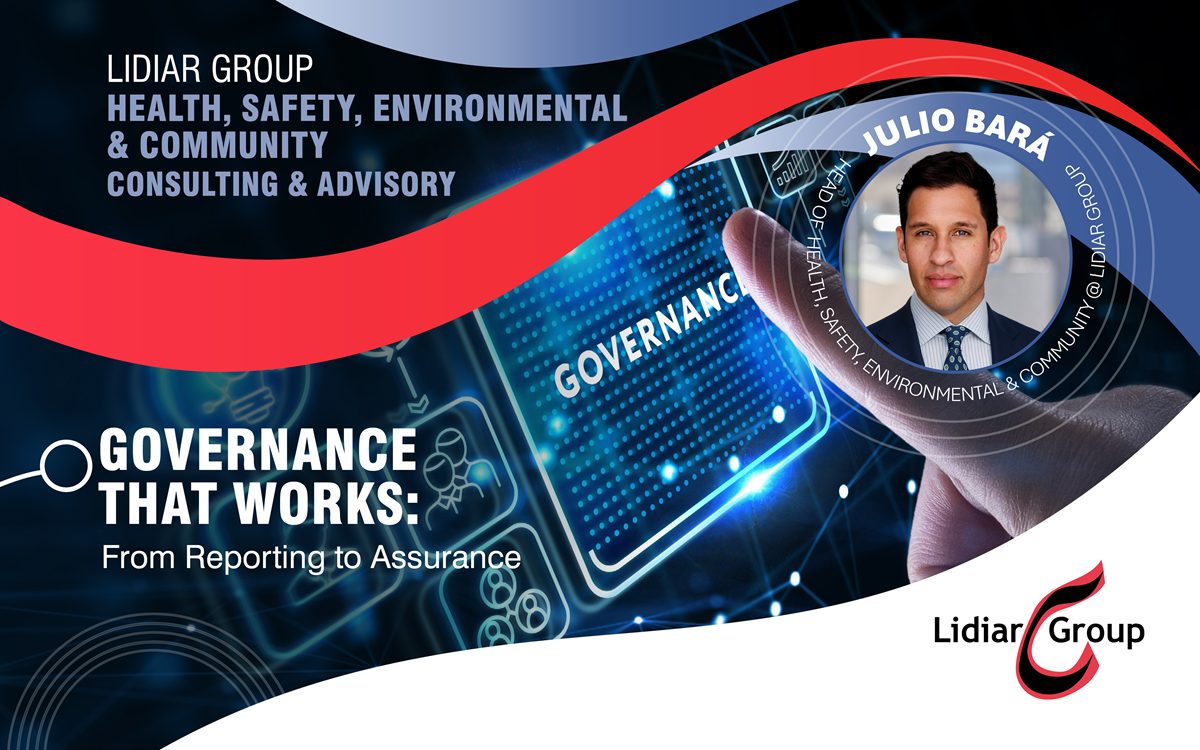
Governance featured prominently at the 2026 OHS Leaders Summit, not as a new concept, but as an area requiring closer examination.
Not because organisations lack frameworks. Most already have them.
The harder question is whether those frameworks are producing real assurance, or simply creating the appearance of control.
Julio Bara said, “We tend to measure governance by its structure, not by its impact. That is where the gap sits.”
That gap shows up most clearly in reporting.
Many organisations produce detailed safety and risk packs. They contain metrics, updates, trends and activity summaries. On paper, they look thorough. But the Summit challenged a more important question: Does the reporting actually help leaders understand what matters most, or does it simply prove that reporting has occurred?
Julio said, “The question is not how much information we provide. It is whether that information helps people understand risk and make better decisions.”
That is the difference between reporting and assurance.
Boards and executives do not need more pages. They need a sharper view of critical risk, the effectiveness of controls, emerging exposure and where challenge is required now. Without that, reporting can become detailed but strangely unhelpful.
The Summit also highlighted how easily risk becomes fragmented. Psychosocial risk sits in one lane. Operational risk sits in another. Technology risk is handled somewhere else again. But work does not experience those issues separately, and neither do leaders trying to make decisions in the middle of them.
Julio said, “When risks are managed in isolation, we lose the ability to see how they combine and amplify each other.”
That is where governance has to do more than maintain structure. It has to connect what would otherwise remain separate.
It also has to keep learning.
Good governance is not static. It responds to new information, shifts with the operating environment, and creates enough challenge that leaders can see not only what is being managed, but what is uncertain, emerging or beginning to drift.
Julio said, “Governance should not just exist. It should learn.”
That may be the most useful way to judge it.
Not by the number of committees or the size of the reporting pack, but by the quality of the questions being asked. Are the real issues visible? Are critical risks clear? Are emerging concerns being surfaced early enough to influence decisions?
If the answer is no, the structure may be in place, but the governance is not yet doing its job.
That is the real shift.
Organisations do not need more governance for its own sake. They need governance that gives leaders confidence that risk is being understood clearly, challenged properly and acted on early enough to matter.
Because the best governance isn’t about appearing perfect.
It’s about supporting people to make good decisions. This is the final article in our 2026 OHS Leaders Summit series. To catch up on the full series, start from Part 1: The Great Safety Correction: Why WHS Must Lead, Not Follow, Digital Transformation – Lidiar Group