
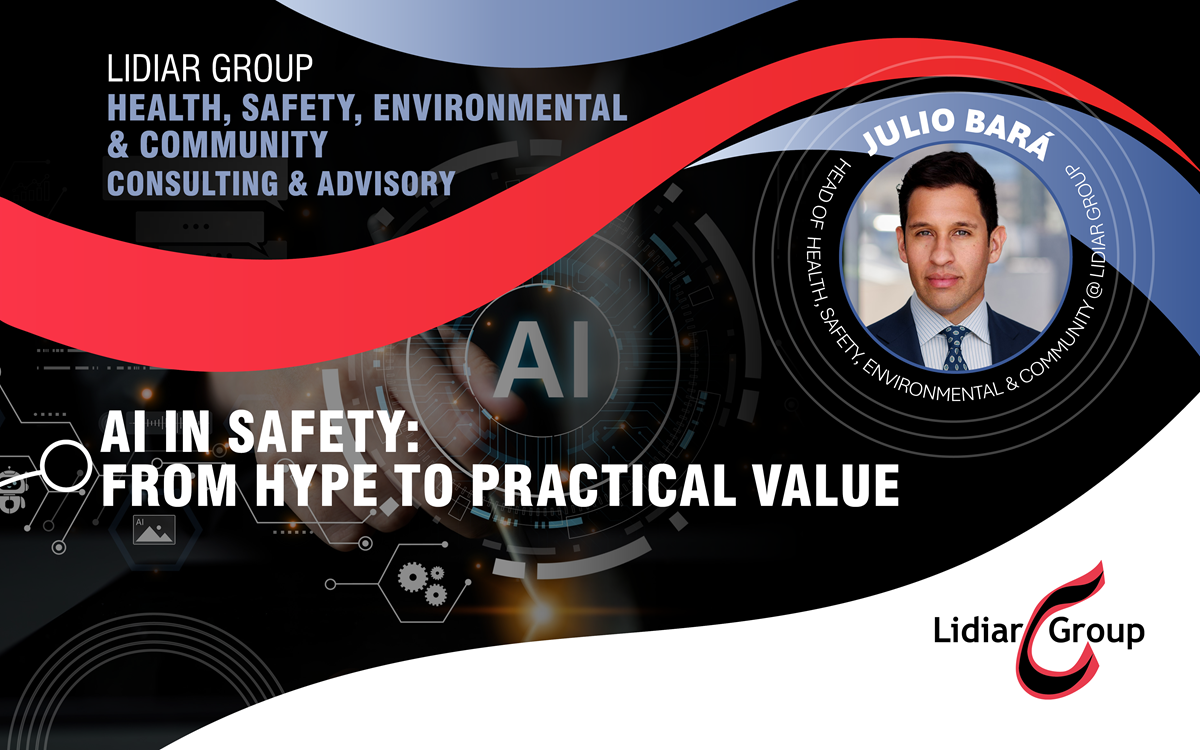
Artificial Intelligence continues to dominate industry conversations, often framed as a transformational force.
At this year’s OHS Leaders Summit, the most useful conversation steered away from the hype and focused on discipline. The real issue was whether organisations were adopting AI with sufficient clarity, governance, and respect for where human judgement must still sit.
Julio Bara said, “There is a tendency to focus on what AI might become, rather than what it can reliably do today.”
Right now, the most practical value of AI in WHS is not replacing professionals. It is reducing low-value administrative load, helping people work through information faster, and creating more time for the work that still depends on human judgement, context and conversation.
Julio said, “The real benefit is enabling safety professionals to spend more time where they add the most value, which is with people.”
But the Summit also made clear that many organisations are moving faster on experimentation than they are on governance. Tools are being tested. Outputs are being used. Yet the boundaries around accountability, verification and appropriate use are often still immature.
Julio said, “AI can support decisions, but it cannot own them. Accountability remains with people.”
That is where the real risk sits.
The issue is not simply whether AI works. It is whether people are clear on what it should be used for, where it can add value, where it must be checked, and what should never be handed over to automation in the first place.
The organisations seeing the most value are not starting with the technology. They are starting with the problem.
Julio said, “The starting point should be the problem, not the technology.”
That sounds simple, but it changes the whole approach. Instead of trying to find a use for AI, they identify a clear friction point, test a narrow use case, build verification into the workflow and keep a human decision-maker firmly in the loop.
Just as importantly, they bring people with them.
If a tool is introduced without context, without engagement and without clarity around its limits, trust starts to erode before value has a chance to build.
Julio said, “If people are not engaged in how technology is introduced, it creates resistance rather than improvement.”
That may be the most practical lesson of all.
AI will have a growing role in safety, but its value will not be determined by novelty. It will be determined by whether it helps people make better decisions, protects judgement where it matters, and improves the way work is actually done.