Queensland’s infrastructure and resources future is bright — but it will test the limits of our industry’s capacity, productivity, and culture.
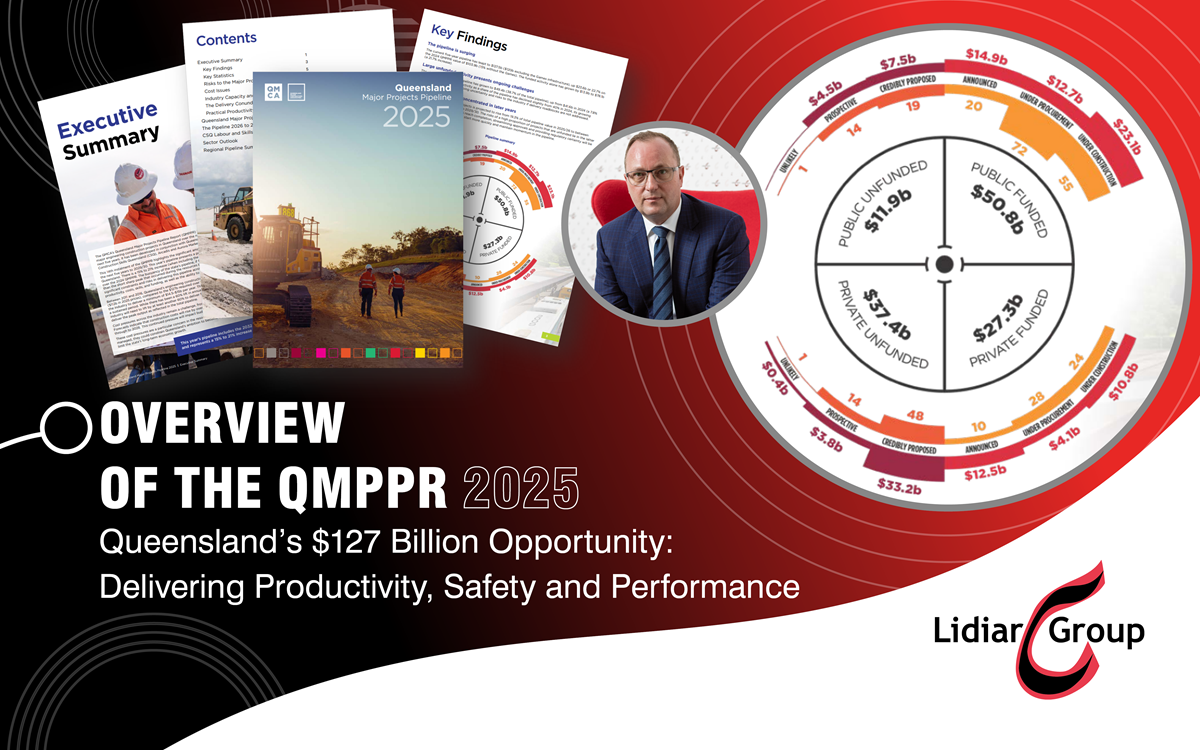
The 2025 Queensland Major Projects Pipeline Report (QMPPR) reveals the state’s project pipeline has surged to $127.5 billion, a 22.7% increase on last year — the strongest forecast in over a decade. The funded portion alone now totals $78.1 billion, supported by major transport, energy, and industrial projects across every region of Queensland.
For Lidiar Group’s Darren Cave, the headline numbers are impressive — but they come with a warning.
“This is a moment that demands bold thinking. The projects are there, the ambition is there, but delivery will depend on how we work together to improve productivity, modernise delivery, and ensure that Queensland remains competitive on the national and global stage.”
Energy and Industry Driving Growth
Energy and industrial projects are the engine of Queensland’s 5-year project cycle. According to the report, these sectors collectively account for $36.6 billion in funding, with renewable generation, storage, and transmission at the forefront.
Mining and Heavy Industry – up to $3.8b and expected to reach $13.8b across the period.
Funded project pipeline for Electricity, Pipeline and telecoms – $22.8b – current to 2029/30
Projects such as Borumba Pumped Hydro, CopperString, and a wave of wind, solar and hydrogen developments in regional Queensland represent both an energy transition and an industrial transformation.
However, with 41.5% of all private unfunded work sitting in the mining and heavy industry categories, investment certainty will depend on efficiency, approvals reform, and cost control.
“The renewable energy build-out is unlike anything we’ve delivered before,” Cave explains. “We’re talking about multi-decade, multi-region projects that require new ways of working: from how we manage risk and resources, to how we keep people safe and productive in remote and high-pressure environments.”
The Productivity Challenge
The QMPPR confirms what many in the field already see daily: rising costs and falling productivity. Construction costs are forecast to rise 7.1% in 2025 and 37% by 2029, while worker productivity has fallen nearly 60% since 2000, from $544,000 to $228,000 per worker per year.
To deliver the current pipeline, productivity must double, or the workforce must triple, which is simply not sustainable.
“You can’t hire your way out of a productivity problem,” Cave says. “We need to work smarter, not just harder, through better planning, leadership, and cultural alignment on-site. That’s where safety and productivity intersect. The safest teams are often the most efficient because they communicate, coordinate, and trust the process.”
A Blueprint for Reform
The QMPPR calls for targeted reforms to drive efficiency and unlock capacity across the sector. These include:
- Flexible industrial relations settings, including practical reform of RDO and heat policy frameworks.
- Streamlined approvals and procurement, cutting red tape and accelerating project start-up.
- Smarter collaboration between government, clients, and contractors, focusing on outcomes, not just compliance.
- Modern construction methods, including modular and off-site fabrication.
- Behavioural reform and site culture improvement, addressing the estimated $8 billion annual productivity loss from inefficient work practices.
Cave says Lidiar Group’s experience across infrastructure, energy and resources projects has shown that project performance is directly tied to culture and communication.
“When we talk about productivity, people often think about time and money. But the real driver is how teams interact — how clearly information flows, how issues are escalated, and how safety, wellbeing and accountability are embedded in the culture,” he says.
“At Lidiar Group, we’ve seen that when teams feel psychologically safe and supported, they deliver better outcomes. It’s not a soft issue; it’s a commercial one.”
Building the Workforce for the Future
The report forecasts that Queensland will require up to 15,600 construction workers for electricity projects alone by 2029/30, a 63% increase on current demand. At the same time, the state currently faces a shortfall of 41,600 workers and with demand for 26,000 construction workers across all sectors, which is expected to peak at 41,000 in 2030.
This capacity crunch reinforces the need for early workforce planning and smarter use of digital tools, design integration, and modular construction methods.
“Workforce sustainability isn’t just about recruitment,” Cave says. “It’s about retention, training, and giving people workplaces they actually want to be part of. That includes leadership that listens, systems that make work safer and simpler, and projects that are planned to succeed before anyone steps on site.”
Delivering the Legacy
For Queensland, the $127 billion pipeline represents more than just projects, it’s an opportunity to reshape how the state builds.
By improving productivity, fostering safer and more collaborative work environments, and modernising delivery methods, the industry can meet this moment with confidence.
“Queensland is at a crossroads,” Cave concludes. “We can either be remembered for a decade of missed opportunities, or for setting a new standard in how projects are planned, delivered, and led. The difference will come down to productivity, people, and culture and that’s where we’re focused.”